Not sure if this is actually from the NCDOT
Weird NCDOT Video
Friday, December 20, 2013


Monday, October 21, 2013
Continuous Warren through truss bridge

A few weeks ago I traveled to Kentucky for an inspection of a Continuous Warren through truss bridge. The truss was built in 1985 (same age as me!). The bridge is in good condition which is surprising since I am use to the corrosion in New England.


The bridge has a total length of 2,314.4 feet with the main span over the Ohio River spanning 740.0 feet. The deck has a width of 44 feet and carries 13th Street one way traffic northbound with three lanes.


It was my first experience with tv news crews being interested in an inspection, sure enough we made it onto the new that evening with video of our lane closure before we asked them to kindly leave our traffic pattern.
Using limited equipment the majority of the inspection was done using rope access or free climbing. The vertical members were inspected by rope with drops up to 84 feet. The top chord was inspected using a simple flip line and always remaining 100% tied off. The chord consists of built up welded members and gusset plates.
Using limited equipment the majority of the inspection was done using rope access or free climbing. The vertical members were inspected by rope with drops up to 84 feet. The top chord was inspected using a simple flip line and always remaining 100% tied off. The chord consists of built up welded members and gusset plates.


Wednesday, October 16, 2013
ASCE 2013 Report Card for America's Infrastructure
In 2013 America's infrastructure received a D+ which has been upgraded from four years ago when the infrastructure received a D.
Here is a quick break down:
Here is there note about my states bridge (Massachusetts)
Here is a quick break down:
Water and Environment
- Drinking Water: The grade for drinking water improved slightly to a D.
- Hazardous Waste: The grade for hazardous waste remained unchanged at a D.
- Levees: Levees again earned a near failing grade of D- in 2013.
- Solid Waste: The grade for solid waste improved in 2013, and it earned the highest grade of B-.
- Wastewater: The grade for wastewater improved slightly to a D.
Transportation
- Aviation: Aviation again earned a D.
- Bridges: With the overall number of structurally deficient bridges continuing to trend downward, the grade improved to C+.
- Inland Waterways: Inland waterways received a D- grade once again as conditions remain poor and investment levels remain stagnant.
- Ports: This new category for 2013 debuted with a grade of C.
- Rail: With high ridership and greater investment in the system, the grade for rail saw the largest improvement, moving up to a C+ in 2013.
- Roads: Targeted efforts to improve conditions and significant reductions in highway fatalities resulted in a slight improvement in the roads grade to a D this year.
- Transit: The grade for transit remained at a D as transit agencies struggled to balance increasing ridership with declining funding.
- Public Parks and Recreation: The grade for parks remained unchanged at a C-.
- Schools: Schools received a D again this year.
- Energy: The grade for energy remained a D+.
For the full report see the ASCE Report Card site which breaks down into each state and category.
Here is there note about my states bridge (Massachusetts)
MassDOT is responsible for the inspection and rating of over 5,000 bridges throughout the Commonwealth of Massachusetts. Approximately 10% of these structures are classified as Structurally Deficient and require either major rehabilitation or replacement. Since the establishment of the $3 billion Accelerated Bridge Program in 2008, MassDOT has focused on replacing or repairing over 200 bridges and has already succeeded in reducing the number of Structurally Deficient bridges at a time when most states have been experiencing increases. MassDOT has accomplished this by implementing progressive construction techniques including utilizing prefabricated bridge elements (such as the Fast-Fourteen Bridge Project on I-93 in Medford) and utilizing self-propelled modular transporters (such as the Route 2/2A project in Phillipston). These innovative techniques reduced the construction duration and thereby limited the inconvenience to drivers. In order to maintain the progress made by the Accelerated Bridge Program, continued funding for the program—which is expected to expire in 2016—is needed. Without this funding, the number of Structurally Deficient bridges will again escalate, impacting safety, resulting in more expensive remedial repairs, and impacting vital transportation links that serve the Commonwealth.
Monday, October 14, 2013
Cantilevered Warren through Truss Bridge (riveted)


The bridge has a total length of 2,277.3 feet with the main span over the Ohio River spanning 738.7 feet. The deck has a width of 22 feet and carries 12th Street one way traffic southbound.


It was my first experience with news crews being interested in an inspection, sure enough we made it onto the new that evening with video of our lane closure before we asked them to kindly leave our traffic pattern.
Using limited equipment the majority of the inspection was done using rope access or free climbing. The vertical members were inspected by rope with drops up to 115 feet. The top chord was inspected using a simple flip line and always remaining 100% tied off. The chord consists of built up riveted members and eye bars with pinned connections.


Besides areas of minor corrosion and minor impact damage the most sever deficiencies were areas of pack rust between gusset plates and pins.


Monday, August 19, 2013
Continuous Prestressed Post-tensioned Segmental Concrete Box Girders

Last week we inspected four ramps in Boston and Cambridge Mass near Leverett Circle and the Boston Sand and Gravel.
The ramps take traffic from the Tobin Bridge to I-93, Zakim BridgeLeonard P. Zakim Bunker Hill Memorial Bridge, Leverett Circle or Storrow Drive. The ramps consist of continuous prestressed post-tensioned segmental concrete box girders.
To inspect the exterior of the box girders an 80' man lift was used since most of the structures were no accessible with smaller lifts due to on going construction and a park. The exterior inspection consisted of visually inspecting the box girders, piers and measuring the bearings for movement.


The interior of the box girders were inspected with three man teams since they are considered a confined space. When inside the box girder the inspection team needs an air meter, rescue air tank and radio, luckily we have only had to carry these once down the interior since there is a hatch at both ends. The interior inspection consisted of visually inspecting (even though we were always within an arms reach)the box girders even though we were always within an arms reach, utilities and measuring the pintle slots for movement.


Friday, August 2, 2013
Tunnel Overhead Inspection

The other week I was out in East Boston to inspect the Callahan Tunnel exhaust plenum as part of the Overhead inspection.


The Callahan Tunnel was constructed in 1960, 60 feet below Boston Harbor. The tunnel has an inside diameter of 28 ' and carries two travel lanes with an ADT of 20,000. We inspected the exhaust plenum from station 8+77.8 to 57+72.1 which comes out to be almost a mile each way hunched over.

The exhaust plenum carries exhaust from the tunnel out at the vent buildings located at each end of the tunnel. The ceiling panels are held up by hangers and supplementary hangers labeled L2, L1, M, R1, R2. The hangers which have gaps require a supplementary hanger that cannot be loose. Many of the hangers have supplementary and very few had gaps without a supplementary
. The concrete liner had numerous hollow areas and a few areas of cracking with efflorescence.


Moving around in the plenum is difficult and depending where in the tunnel the air can be come very still and hot. By the end of each day your clothes, mask and exposed skin are covered in soot. This is pretty common when inspecting an exhaust plenum though.


Friday, July 12, 2013
Natural Bridge in Virginia

Last week on vacation I took a road trip down to Kentucky and Tennessee. On the way back I stopped at the Natural Bridge in Virginia.

The natural arch spans 90 feet across Cedar Creek and is up to 215 feet over the creek floor and consists of a limestone strata. The bridge carries US highway 11 and when cross the bridge has fencing so you can't see the view from the top (believe me I tried).


Monday, July 8, 2013
SPRAT Level I Rope Access Training
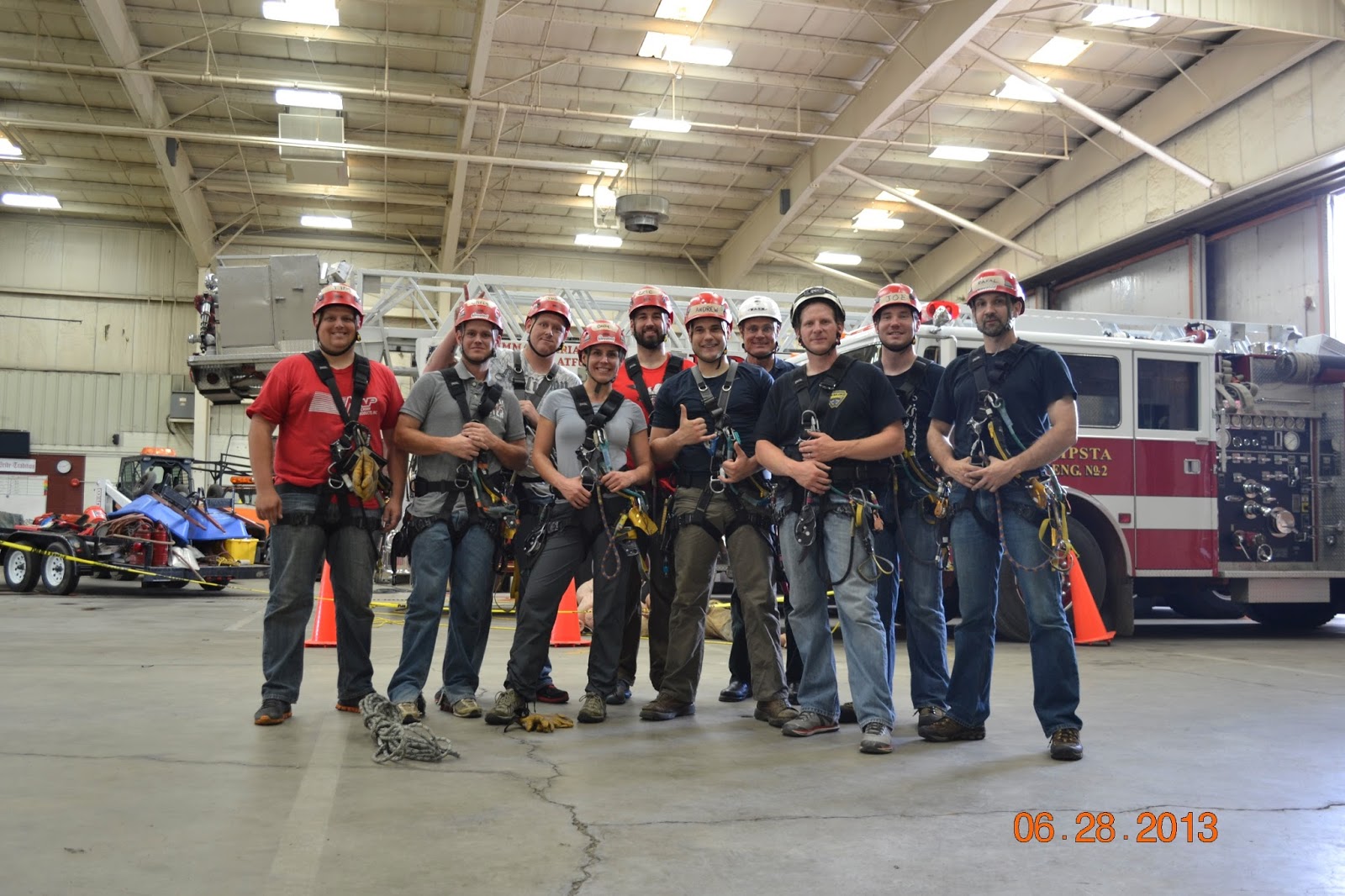
Two weeks ago I attended SPRAT Level I rope access training in Chicago. Going into the class I thought it was be easy and at most be fighting off boredom while hearing about the dangers and procedure of rope access for hours before actually getting on the ropes.
It only took 60 minutes before I knew this class was unlike any I had ever taken before. After going over the fundamentals we strapped on our climbing harness and headed out to the "hazard zone".

Day 1:
First we were shown what equipment is used for ascending and descending, we also went over our back-up devices (fall protection). Next our instructors went over how to ascend and then switch over to descending. Then we were shown how to descend. It sounds very easy but seeing it for the first time looked and was more difficult than they made it look.
After practicing for a while we took a break and went over some of our equipment (helmet, harness and carabiner).
Next we were shown how to switch from one rope set up to another. First ascending one rope setup, switching to descending and finally ascending on the second rope setup. After reaching a stopping point or your area of work/inspection you descend from your first rope setup which makes you plum over your second anchorage.


Day 2:
Our second day we started off learning how to do a long re-belay which is close to switching from one rope to another but accentually doing it one four rope setups. This will be used a lot for inspections over areas which can not have hanging ropes or do not have anchor points directly above your point of inspection.
Next we were shown how to pass a mid-line knot. Not much to explain here but like everything else it was a little tricky at first.
Next we took a break and learned more about our back up devices (Kong and ASAP) and our I'D (industrial descender).
After we went over deviations which is where your ropes are pulled away from the anchor point to avoid an object such as a cantilevered overhang.
With a nice lunch break we gained back some strength and learned how to perform a rescue with a person in descent. This was one of the more difficult processes with lots for steps. Our first attempts took a while but were all successful.

Day 3:
Today we started off with a long commute to class due to flash flooding in the Chicago area. After passing through roads with up to two feet of standing water we finally made it to class.
Once in class we reviewed our up coming test questions and practiced some of the techniques we had learned in previous days.
Next we were shown how to do
edge
negotiations, which is the process of ascending up and over an end or descending down from an end. For most of our inspections we will be using this multiple times and it uses up a lot of energy.
After lunch we started off with learning how to set up anchorages and set-ups.
Next we learned more about our handled ascender, pulley and sling and reviewed the information in each pieces manual.

Day 4:
Practice makes perfect! Today we worked hard practicing everything we learned and perfecting anything we felt needed improvement. For me I practiced rescues, edge negotiations and long re-belays.
Day 5:
Test day.
Written 40 question multiple choice. (Slipped up and got one wrong)
Oral Test I had to explain everything there is to know about helmets (there is more than you think there is)
Finally we get on the ropes and show them everything we know.
Everyone in our class passed with flying colors.
If you're looking into taking a SPRAT rope access class I highly recommend Elevated Safety they have a great group of instructors who are friendly, knowledgeable and have work experience in multiple fields. Just in our class we had 5 bridge and transportation engineers, 2 rock fall guys and a historical façade restoration.
Subscribe to:
Posts (Atom)