Showing posts with label Tunnel. Show all posts

Monday, April 7, 2014

Overhead Tunnel Inspection


A few weeks ago we started the inspection of Tip O'Neill Tunnel in Boston. All of the work is conducted at night when the state is able to close down portions or all of the lanes in the tunnel.

The work from the bucket truck is pretty easy and clean. Mainly we have just had to worry about dressing warm since a few nights have dropped to 10°F (-12°C). 

The dirty work is having to inspect the exhaust plenums which are considered to be permit required confined space. Much like their name suggests they are full of exhaust and caked with soot.


Friday, August 2, 2013

Tunnel Overhead Inspection


The other week I was out in East Boston to inspect the Callahan Tunnel exhaust plenum as part of the Overhead inspection.


The Callahan Tunnel was constructed in 1960, 60 feet below Boston Harbor. The tunnel has an inside diameter of 28 ' and carries two travel lanes with an ADT of 20,000. We inspected the exhaust plenum from station 8+77.8 to 57+72.1 which comes out to be almost a mile each way hunched over.


The exhaust plenum carries exhaust from the tunnel out at the vent buildings located at each end of the tunnel. The ceiling panels are held up by hangers and supplementary hangers labeled L2, L1, M, R1, R2. The hangers which have gaps require a supplementary hanger that cannot be loose. Many of the hangers have  supplementary and very few had gaps without a  supplementary . The concrete liner had numerous hollow areas and a few areas of cracking with efflorescence.  


Moving around in the plenum is difficult and depending where in the tunnel the air can be come very still and hot. By the end of each day your clothes, mask and exposed skin are covered in soot. This is pretty common when inspecting an exhaust plenum though.


Wednesday, June 5, 2013

Overhead Tunnel Inspection


The Tip O'Neill Tunnel was opened 10 years ago and carries the Central Artery below Boston's downtown area.  The overhead inspection consists of the exhaust plenums, roof slab, utilities and lighting.

The tunnel's ceiling is has fireproofing throughout the underside which makes it difficult to determine the condition. Areas of the ceiling fireproofing have been removed to access utilities and allow inspectors to view the roof slab. The exposed areas of the slab show localized hairline cracks.


The lighting along the top of the walls have been connected with metal clips which are prone to failing and now have six acetal zip ties. The majority of the metal clips are in place with six ties but a few of the lighting structures have loose clips or broken ties causing displacement and cracked lenses. 


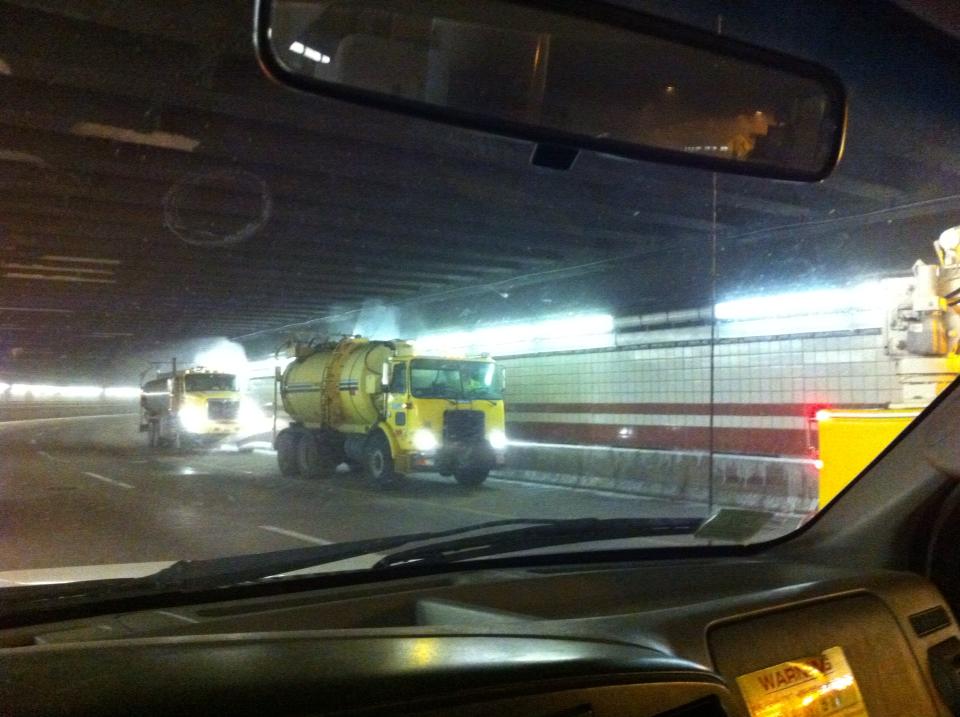
To access the tunnel the we piggybacked with MassDOT as they cleaned the tunnel. It was pretty interesting being able to see how the tunnel was cleaned. First the safety walks were cleaned of debris using some sort of leaf blower. Secondly the walls were sprayed with some type of soap solution at a high pressure. Next they were scrubbed. After that the walls were scrubbed by a dozer with a brush attachment. After the brushing a water truck with attached power washer sprayed off the wall. Finally the lanes were cleaned using street sweepers. The entire time the exhaust fans were blowing to help clear out any dust. It's great to see them maintaining the structures since we don't always get to actually witness it.