Friday, February 18, 2011

Inverset Units from the Central Artery


Today I went up to Littleton MA to check dimensions on inverset units for a bridge that we are designing in Conway MA. The inverset units were used during the "Big Dig" while the Central Artery was being demolished. The units were designed to be re-used after the project in small bridges across Massachusetts.

The units we were looking at consists of three sections that will be assembled to complete the bridge much like double T's showing up at the site.

The project site in Conway is somewhat of a rural area, so it will be great to see these units reduce the construction time and labor at the site.
Bald Eagle out in Conway MA
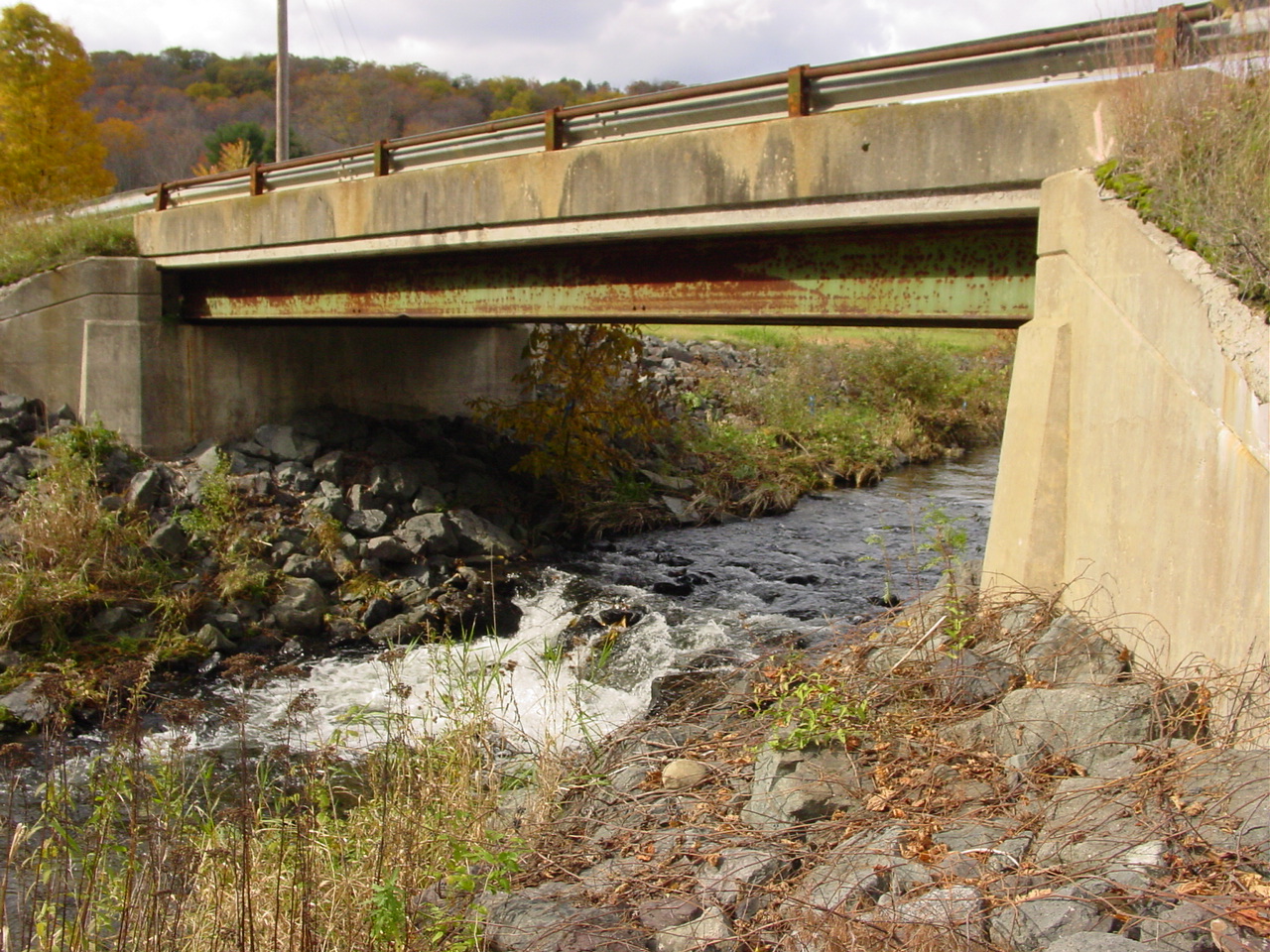
Existing bridge in Conway to be replaced
This also reminded me of something I saw the other day showing abandoned projects that were to meant to be part of the green way were the Central Artery once was. I completely agree with most of the projects being abandoned but I wish the YMCA had been given a chance since it would have improved the North Station area greatly.
Lard in Littleton MA where some of the Inverset Units are stored for later use
Back to inverset units tho. These units will allow Massachusetts to quickly improve their infrastructure greatly by replacing small deteriorated structures throughout the state. Hopefully the Accelerated Bridge program at MassDOT will realize the full potential of these units before the units themselves deteriorate.

57 degrees out and still have snow up to our knees

Thursday, February 17, 2011

Impact Damage with Broken Welds and Cracked Web

The past two days I was down in Taunton MA at a bridge which spans over Route 140. The rolled steel beam bridge with cover plates was built in 1959 and rehabilitated in 2004 with a new composite deck and railings.
With minor impact gouges on the underside of most of the beams it was only a matter of time before a truck not paying attention to the vertical clearance (14.90' Northbound and 14.74' Southbound) would hit the bridge. Something caused severe damage to Beam #8 (the South most beam in Span #1), deforming the web, bottom flange and cover plate. The impact also cause the web to crack at the diaphragm connections cracking the web to Beams #8 and #7 and braking the weld to Beam #6.
Checking out cracks

POV of a bridge inspector
The state added arrest holes to stop the cracks from propagating and to this date have not expanded past the arrest holes. One vertical rack along the weld on Beam #8 did not have an arrest hole and after doing a Dye Penetrant Test we determined that the crack had not change since the last inspection. 
Broken weld
  
Cracked web with arrest holes

Web pushed outward to the East

Cleaning crack for dye penetrant test prep

After adding dye
Dye Penetrant Test complete showing full extents of the cracking

Section loss at beam ends

Bridge Shielding

Just received a memo from MassDOT for adding a new item to our bridge inspections. MassDOT believes that during inspections the condition, location and material of the shielding should be addressed and I fully agree with them.
MassDOT's district bridge maintenance uses three types for shielding currently (Timber, Expanded Metal and Fabric Wrap) which I have seen at a few bridge located over highways. Even though we have always noted any deficiencies with the shielding in the past, now we will have a guideline for how to address the state before there is a serious problem.

Friday, February 11, 2011

Roadway Worker Protection

Last week I took my Roadway Worker Protection (RWP) training course to be certified to enter the Massachusetts Bay Commuter Railroad (MBCR) right of way. This was my third time taking the class (needs to be taken each year) and as usual I end up with a card with a horrible picture of me. I am still waiting to take my AMTRAK safety class which was cancelled due to the large amount of snow we received. The AMTRAK course is pretty much the same but ends up focusing more on the catenary system.

Thursday, February 10, 2011

Becket and Chester Public Hearing Prep

Yesterday I was busy preparing plans for an up coming public hearing for designs we have in Becket and Chester MA. The plans will show a rough idea of what the finished projects will look like. Here are a couple of the rough drafts of the rough plans will look like and construction staging.


Friday, February 4, 2011

Memorial Boulevard Rigid Frame

Back in July of 2009 I rated a rigid frame in Providence RI which carries Memorial Boulevard over a pedestrian underpass. The frame spans 40 feet allow foot traffic to the Providence and Woonsaquatucket River where each year the Waterfire festival is held. The frame was constructed in 1994 and has several unique features.

The reason I remembered this bridge is from reading tallbridgeguy's post on Green Bridge and Landscaping, where he mentions the positives of adding flower plants and trees along with negatives freeze/thaw (a big problem in New England), drainage, extra load and maintenance.

Along with planters the bridge also has a glass atrium which allows light to the underside of the frame and decorative tiling along the legs of the frame.
These decorative accents help create an aesthetically pleasing bridge which is the goal for both a consultants and a necessity for clients when it comes to pedestrian traffic. When it comes to this bridge tho these accents can cause problems down the road. As most would suspect the glass atrium now has several broken panes, the tiles do not allow for inspection of the legs and the underside of the roof below the plants have cracking with efflorescence, incrustation and stalactites. 
The rating of the concrete rigid frame was performed using influence lines to determine the maximum live load effects and we treated the rigid frame's support conditions as pinned-pinned.
The architectural “waffling” on the underside of the rigid frames was not considered as a structural component and was not taken into account as part of the section properties. 
  

Tuesday, February 1, 2011

Prestressed Concrete I-Beam Rating

Last February I worked on a rating for MassDOT on two simple span prestressed concrete I-beam bridge with an 8" composite deck. The bridges were built in 1982 and carries route 146 through Sutton MA. The bridges span 78'-4" with a 8°-22'-09" skew.


I used Virtis to perform the rating of the prestressed concrete I-beams.  The rating of the reinforced concrete deck was computed by hand in accordance with the AASHTO Standard Specifications and MassHighway Bridge Manual.

The prestressed concrete I-beams have a set of 16 straight low relaxation strands and 7 harped or draped relaxation strands. At first I had trouble modeling the beams in Virtis and would come up with rating factors lower than 0.05. At first I thought the strand pattern may have been incorrect or a material was entered wrong. After exhausting all the typical mind fart errors, we were able to figure out a problem with the live load modeling.


When we inspected the bridge to confirm measurements and gather other information we noticed that the majority of the prestressed beam ends had areas of rust staining with minor cracking throughout but nothing serious enough to effect the rating.