Showing posts with label Rating. Show all posts

Monday, February 27, 2012

Mississippi Truss Rating

Starting to help our Mississippi office with some truss ratings.

Several of the trusses do not have plans and measurements of all the members and deficiencies had to be taken.

On Friday I started a Truss in Hinds-Warren County which spans over Big Black River and carries Old Highway 80. The bridge consists of ten approach spans to the west and one east. The main truss spans 170 feet and has 8 panels.Currently I'm just checking the net area for the measured members for section properties and dead load calculations.


Tuesday, October 18, 2011

Steel Multi-Beam with Cover Plate Rating

Started my second rating today. The bridge is located in Newport RI and is near "THE" Newport bridge which I inspected a few weeks ago.

The bridge consists of ten rolled steel beams which span 86'-1" and carries RI 138 with a composite concrete deck and asphalt wearing surface. The bridge has a line of summitry along the median which made the rating slightly easier from a ten beam system to two five beam systems. I ended up choosing a typical exterior and interior beam and both fascia beams which displayed section loss at the abutments.

After choosing the beams to rate, I calculated the dead loads and live load factors and then I calculated the equivalent plate geometry to account for beams with section losses. Since BRASS-GIRDER does not include a command for section loss the beams were modeled as plate girders with section properties that compare to the rolled beam.
I then moved onto setting up the BRASS-Girder input file, which were broken down into as built and as inspected for those with section loss.

Thursday, October 13, 2011

Weathering Steel Multi-Girder Rating


Started the new job last Monday and jumped on a rating right away.

The rating is part of a contract for RIDOT and is a steel multi-grider system with a composite deck. The bridge is located in downtown providence and spans 102 feet over the Woonasquatucket River.

First I calculated the dead loads and live load factors and then I moved onto setting up the BRASS-Girder input file.

The bridge had for bays with different types for utilites which made selecting which girders to rate a little more difficult.

Its been over a year since I last used BRASS so I had to shake out some of the rust (lots of errors and looking up most of the input order). After about three tries I was finally able to get it to run correctly.

Friday, February 4, 2011

Memorial Boulevard Rigid Frame

Back in July of 2009 I rated a rigid frame in Providence RI which carries Memorial Boulevard over a pedestrian underpass. The frame spans 40 feet allow foot traffic to the Providence and Woonsaquatucket River where each year the Waterfire festival is held. The frame was constructed in 1994 and has several unique features.

The reason I remembered this bridge is from reading tallbridgeguy's post on Green Bridge and Landscaping, where he mentions the positives of adding flower plants and trees along with negatives freeze/thaw (a big problem in New England), drainage, extra load and maintenance.

Along with planters the bridge also has a glass atrium which allows light to the underside of the frame and decorative tiling along the legs of the frame.
These decorative accents help create an aesthetically pleasing bridge which is the goal for both a consultants and a necessity for clients when it comes to pedestrian traffic. When it comes to this bridge tho these accents can cause problems down the road. As most would suspect the glass atrium now has several broken panes, the tiles do not allow for inspection of the legs and the underside of the roof below the plants have cracking with efflorescence, incrustation and stalactites. 
The rating of the concrete rigid frame was performed using influence lines to determine the maximum live load effects and we treated the rigid frame's support conditions as pinned-pinned.
The architectural “waffling” on the underside of the rigid frames was not considered as a structural component and was not taken into account as part of the section properties. 
  

Tuesday, February 1, 2011

Prestressed Concrete I-Beam Rating

Last February I worked on a rating for MassDOT on two simple span prestressed concrete I-beam bridge with an 8" composite deck. The bridges were built in 1982 and carries route 146 through Sutton MA. The bridges span 78'-4" with a 8°-22'-09" skew.


I used Virtis to perform the rating of the prestressed concrete I-beams.  The rating of the reinforced concrete deck was computed by hand in accordance with the AASHTO Standard Specifications and MassHighway Bridge Manual.

The prestressed concrete I-beams have a set of 16 straight low relaxation strands and 7 harped or draped relaxation strands. At first I had trouble modeling the beams in Virtis and would come up with rating factors lower than 0.05. At first I thought the strand pattern may have been incorrect or a material was entered wrong. After exhausting all the typical mind fart errors, we were able to figure out a problem with the live load modeling.


When we inspected the bridge to confirm measurements and gather other information we noticed that the majority of the prestressed beam ends had areas of rust staining with minor cracking throughout but nothing serious enough to effect the rating.  


Wednesday, January 26, 2011

ACROW Truss Rating


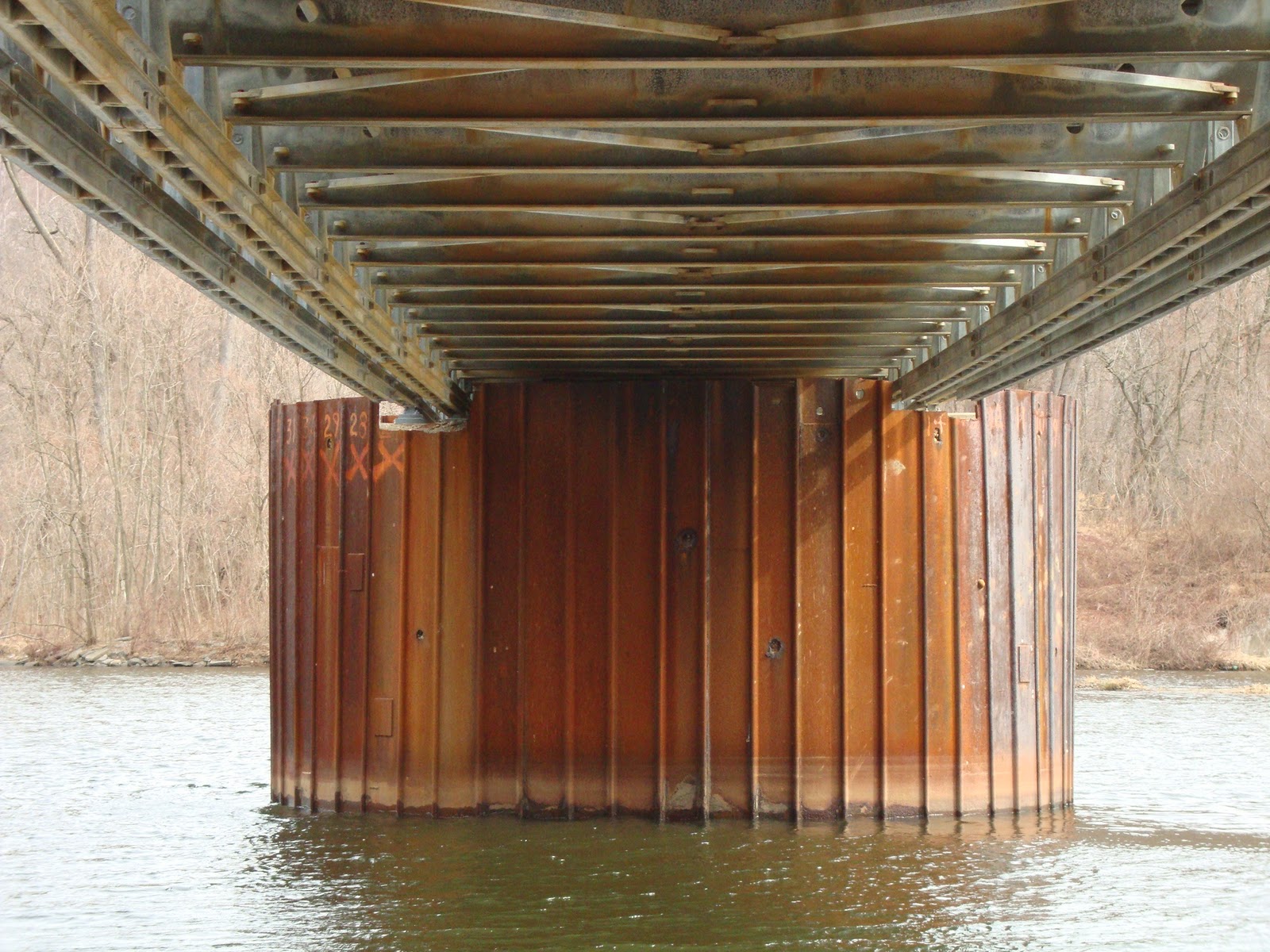
Back in March I finished a rating for an ACROW temporary truss located in Russell MA. The bridge was constructed in 1986, to allow access to a factory after truck traffic was stopped over a now closed three span arch. The bridge spans over the Westfield River near a large mill and dam.
The three spans consist of two double single reinforced and one double double reinforced trusses.
The rating was our first ACROW rating and was pretty complex, we were able to break the rating down into 6 different parts.
First we checked the deck which consists of several 2.33' x 4.97' panels that weigh 282 pounds.
Next we looked at the transoms (floorbeams) which we treated as a simple span between the two truss members.
After the transoms we looked at the shear at the pinned connections which are located at each truss panel.
We then looked at the shear at the supports looking at the top and bottom cords which consist of eight to twelve channels.
Then we looked at the flexure near midspan using the section modulus of the truss and the dead load and live load moments.

Finally we checked the buckling of the top cord which ended up being the most complex part of the rating.
The bridge is located in a beautiful area which I will have to visit again.