Monday, March 21, 2011

Cumberland Pony Truss Bridge Inspection

So last week I ran out of time catching up on past inspections, so here are a few I missed. Last Monday I was out in Cumberland to complete two inspections which were post posted due to high water.


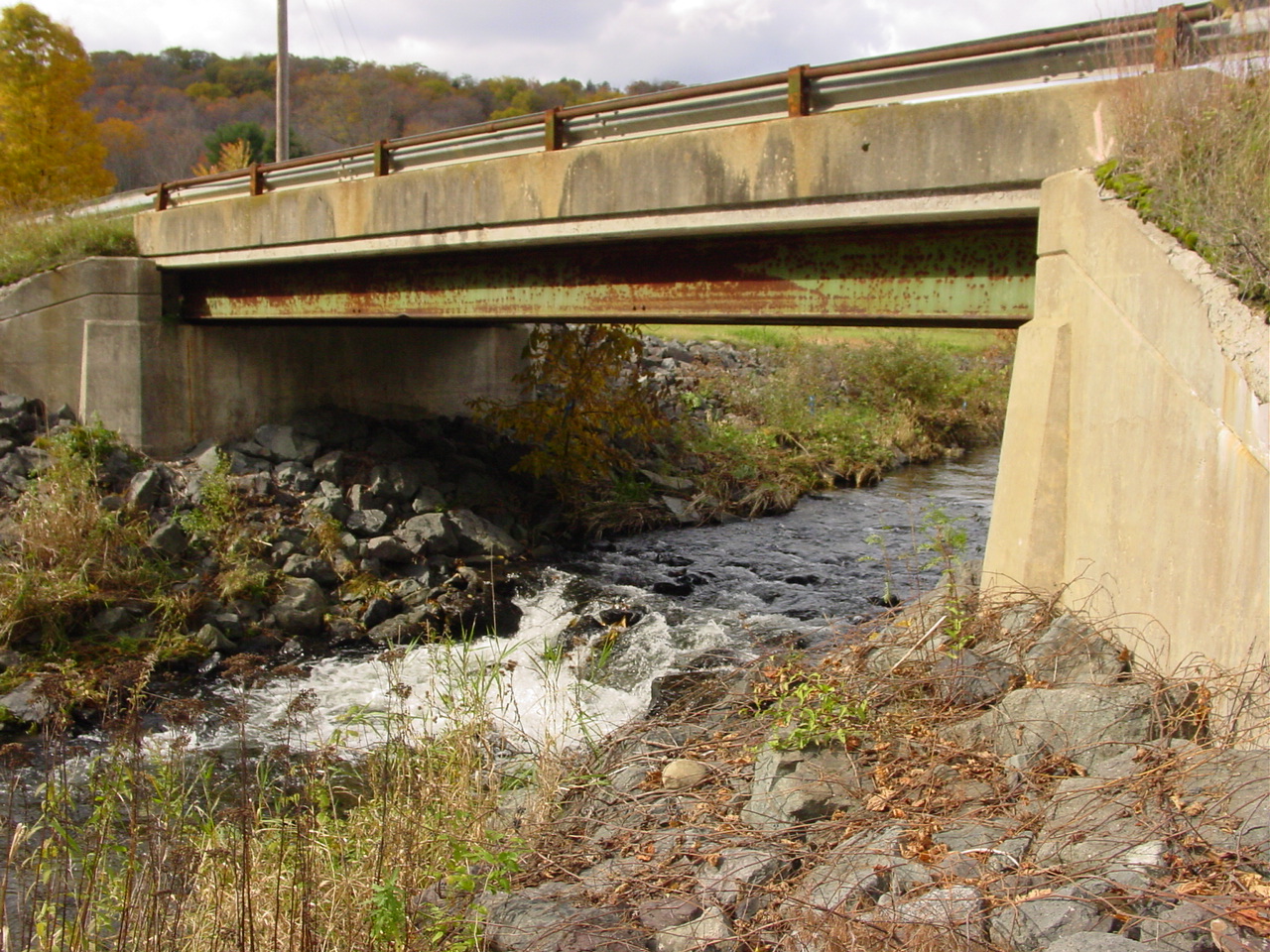
This first bridge is a small simply supported rolled beam bridge which 20 feet over Abbott Run Canal. During the inspection RIDOT stopped by to do a quality control check and one of them informed us that the nice house spanning over the canal has a glass floor to see down to the canal below.


The bridge was rebuilt in 2006 and replaced the previously posted bridge which was built in 1886. The rebuilt bridge incorporated the original exterior girders and rail for aesthetics and only support their own self weight. 
We inspected the bridge in waders and used a 16 ft ladder. We joked before the inspection after reading the previous inspection which stated "Exercise caution when wading in channel upstream and downstream of the bridge. The channel bottom is very soft consisting of decomposed organic material" seeing a channel which was just over 12 inches at most. Sure enough after taking an elevation photo and fell 4 feet into muck, good thing I'm over 6 feet or this could have been a bigger deal. Forgot to take a picture of the hole afterwards.

The rest of the inspection went smoothly tho and we were able to finish up and head down the street to our next bridge. 
Much like the last bridge, this is also a rolled steel beam bridge with a timber deck and also spans 59.5 feet over Abbott Run. This bridge was rebuilt in 2007 and replaced the existing bridge which was built in 1886. The original built up steel thru pony truss remains for aesthetic purposes and carries its self weight.


The bridge was quite noisy with a loose timber plank that had missing clamps on the underside to the steel beams. While wading in the channel we got freaked out when something swam between our legs and through the mucky water, but after we realized it was a fish we had a good laugh. 


Wednesday, March 16, 2011

Bridge Inspection Catch up

The past week or so I've been busy out in the field with inspections so I'll try to post a few quickies.

Last week I was out in Sharon inspecting two plate girder bridges which span over I-95. The bridges consist of three simple spans with seven (7) plate girders. The spans over I-95 were inspected Tuesday and Wednesday nights with a 30 ft bucket truck with traffic control and two Mass State Troopers.

This was my first MassDOT inspection since they added a new shielding item. Accounting for the new item didn't take that much longer and will be helpful for the state in the future. The bridge had expanded metal deck shielding over I-95 to prevent falling debris from hitting the roadway or travelers.


Monday (day) we headed back down to Sharon to inspect the tops of the two bridges and take some typical photos in the day light. 


Friday, March 11, 2011

Temporary Repairs to the Bowker Overpass

The Bowker Overpass, which spans over Storrow Drive, had to be shut down early this morning for emergency repairs. With a large pothole opening up traffic was shut down until almost lunch time. Small problems like this should be reminders that small problems during the summer and fall inspections can become larger and more expensive as soon as freeze/thaw hits.

Thursday, March 3, 2011

New MassDOT Ratings

Just received a new assignment from MassDOT to rate seven bridges out in central and western Mass. (Becket, Lee, Leverett, Monterey, Russell and two in Ware).

Also just heard that we will be doing the routine inspections for the Northern half of the Amtrak bridges in Rhode Island. One and half years ago I inspected the Southern half so after this I will have seem the majority of the Amtrak bridges in RI, YEAH!

Friday, February 25, 2011

Precast Abutment Adjustments

Today I'm working on plans for adjusting MassDOT standards for a bridge design. This project is being designed to decrease on site construction time by using as many precast elements as possible. At the moment I'm making changes to the approach slabs, safety curb, elastomeric bearings and endposts. 

Thursday, February 24, 2011

Finishing up Ratings

This week I've been busy finishing three ratings which are due before I begin Rhode Island inspections. Today I finished the Hybrid Steel Girder in Wrentham MA and will soon be finishing the second Hybrid Steel Girder which has two girders with section loss which I am currently checking for buckling and crippling. The third bridge is a box culvert in Fitchburg MA which has taken some extra analysis to check extra points which BRASS Culvert does not check.

Friday, February 18, 2011

Inverset Units from the Central Artery


Today I went up to Littleton MA to check dimensions on inverset units for a bridge that we are designing in Conway MA. The inverset units were used during the "Big Dig" while the Central Artery was being demolished. The units were designed to be re-used after the project in small bridges across Massachusetts.

The units we were looking at consists of three sections that will be assembled to complete the bridge much like double T's showing up at the site.

The project site in Conway is somewhat of a rural area, so it will be great to see these units reduce the construction time and labor at the site.
Bald Eagle out in Conway MA
Existing bridge in Conway to be replaced
This also reminded me of something I saw the other day showing abandoned projects that were to meant to be part of the green way were the Central Artery once was. I completely agree with most of the projects being abandoned but I wish the YMCA had been given a chance since it would have improved the North Station area greatly.
Lard in Littleton MA where some of the Inverset Units are stored for later use
Back to inverset units tho. These units will allow Massachusetts to quickly improve their infrastructure greatly by replacing small deteriorated structures throughout the state. Hopefully the Accelerated Bridge program at MassDOT will realize the full potential of these units before the units themselves deteriorate.

57 degrees out and still have snow up to our knees

Thursday, February 17, 2011

Impact Damage with Broken Welds and Cracked Web

The past two days I was down in Taunton MA at a bridge which spans over Route 140. The rolled steel beam bridge with cover plates was built in 1959 and rehabilitated in 2004 with a new composite deck and railings.
With minor impact gouges on the underside of most of the beams it was only a matter of time before a truck not paying attention to the vertical clearance (14.90' Northbound and 14.74' Southbound) would hit the bridge. Something caused severe damage to Beam #8 (the South most beam in Span #1), deforming the web, bottom flange and cover plate. The impact also cause the web to crack at the diaphragm connections cracking the web to Beams #8 and #7 and braking the weld to Beam #6.
Checking out cracks

POV of a bridge inspector
The state added arrest holes to stop the cracks from propagating and to this date have not expanded past the arrest holes. One vertical rack along the weld on Beam #8 did not have an arrest hole and after doing a Dye Penetrant Test we determined that the crack had not change since the last inspection. 
Broken weld
  
Cracked web with arrest holes

Web pushed outward to the East

Cleaning crack for dye penetrant test prep

After adding dye
Dye Penetrant Test complete showing full extents of the cracking

Section loss at beam ends

Bridge Shielding

Just received a memo from MassDOT for adding a new item to our bridge inspections. MassDOT believes that during inspections the condition, location and material of the shielding should be addressed and I fully agree with them.
MassDOT's district bridge maintenance uses three types for shielding currently (Timber, Expanded Metal and Fabric Wrap) which I have seen at a few bridge located over highways. Even though we have always noted any deficiencies with the shielding in the past, now we will have a guideline for how to address the state before there is a serious problem.